
Inspiring Change Every Day with Grace
Transactional Vs Transformational Relationships

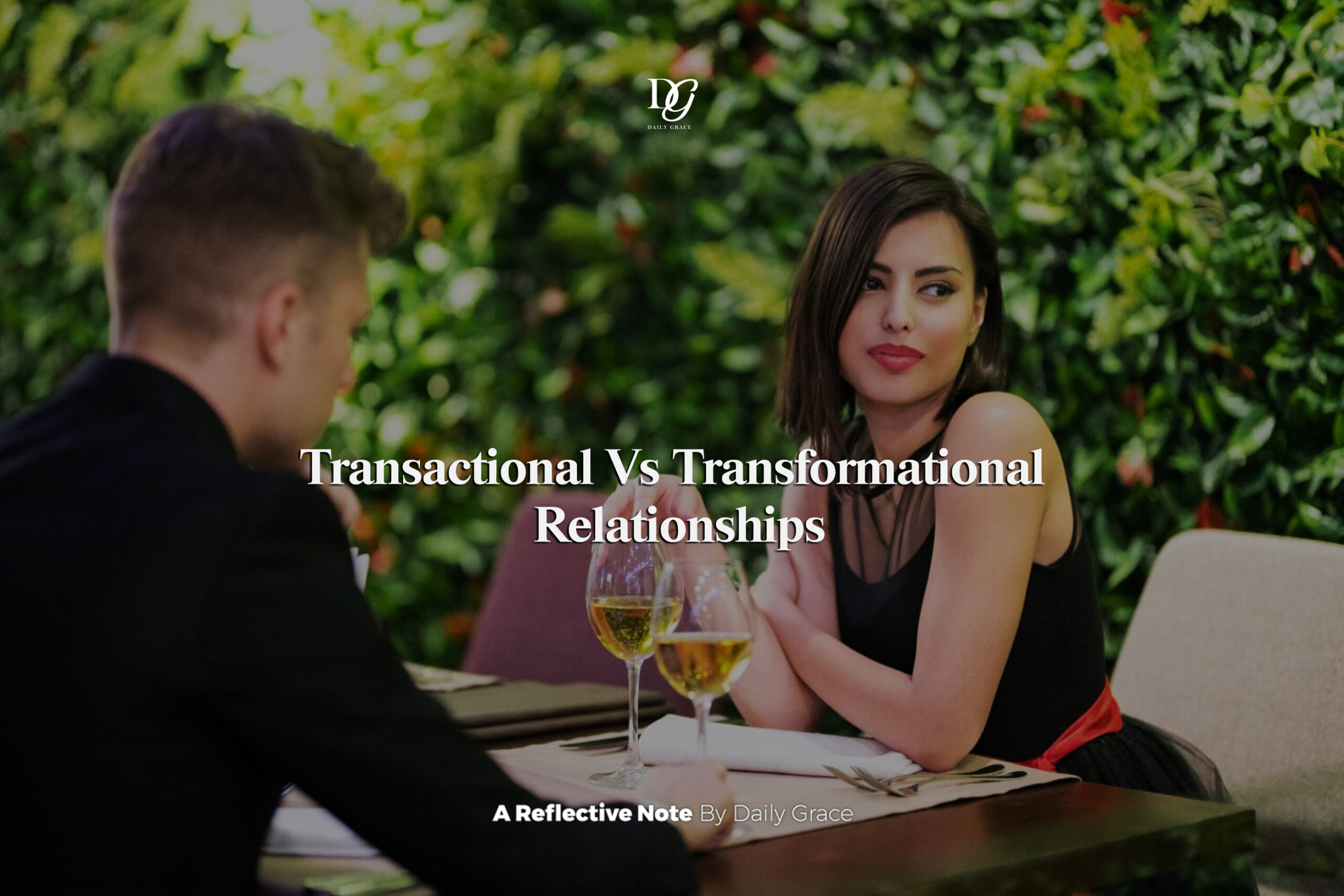
Not all relationships are meant to last, but all of them will shape you. The real question is how? Some relationships are transactional, they exist for exchange, access for opportunity, attention for validation or help for convenience.
Others are transformational, they stretch you, refine you, confront you, and develop you. Relational intelligence is the ability to know the difference, and more importantly, to decide which kind you are willing to invest your life in.
A transactional relationship is not always malicious. It simply operates on benefits. When the benefit fades, so does the bond. You see this in friendships that go silent when you can no longer provide emotional labour. In partnerships where affection declines when status or income shifts. The connection feels strong while the exchange is active. But underneath, there is a quiet calculation. The relationship survives on usefulness.
Transformational relationships feel different. They are not always comfortable, and they are rarely flashy. They may challenge your habits, question your thinking, and hold you accountable. At times, they feel inconvenient because growth is inconvenient. But you leave those interactions wiser, steadier, and expanded. These relationships are less concerned with what you give and more concerned with who you are becoming. They are invested in your evolution, not just your contribution.
The truth about relational intelligence is this: what should guide your choices is not how good someone makes you feel today, but how consistently they help you grow tomorrow. Feelings can be intoxicating. Validation can be addictive. Being needed can feel like being valued. But being needed is not the same as being respected. And being admired is not the same as being developed.
There is also a harder truth to face. Sometimes you are not being used, you are volunteering for transactional roles because they feel safer. It feels easier to be the helper, the provider, the rescuer, the entertainer, the strong one. In those roles, you control your value. But transformational relationships require vulnerability. They require you to be seen beyond your utility. That can feel unsettling. So you settle for exchanges instead of elevation.
Relational intelligence grows when you start evaluating relationships with better questions. Does this connection only activate when I am useful? Do I shrink or expand around this person? Are we both growing, or is one person carrying the emotional weight? Over time, patterns reveal motives. You do not need suspicion; you need observation. Healthy relationships show mutual investment, mutual correction, and mutual growth.
To build transformational relationships, you must become transformational yourself. That means showing up with integrity, being open to feedback, offering support without keeping score, and choosing depth over convenience.
It means setting boundaries when someone reduces you to your function. It means being willing to walk away when growth is impossible. Relational intelligence is not about cutting people off at the first flaw; it is about discerning whether the foundation is exchange or evolution.
In the end, transactional relationships may fill your calendar, but transformational ones shape your character. One gives you a temporary advantage. The other gives you lasting maturity.
©️ No Copyright infringement intended.PS: Kindly Follow our WhatsApp Channel at https://whatsapp.com/channel/0029VawUlQGBPzjQXzs6fX2Q for more engaging content.