
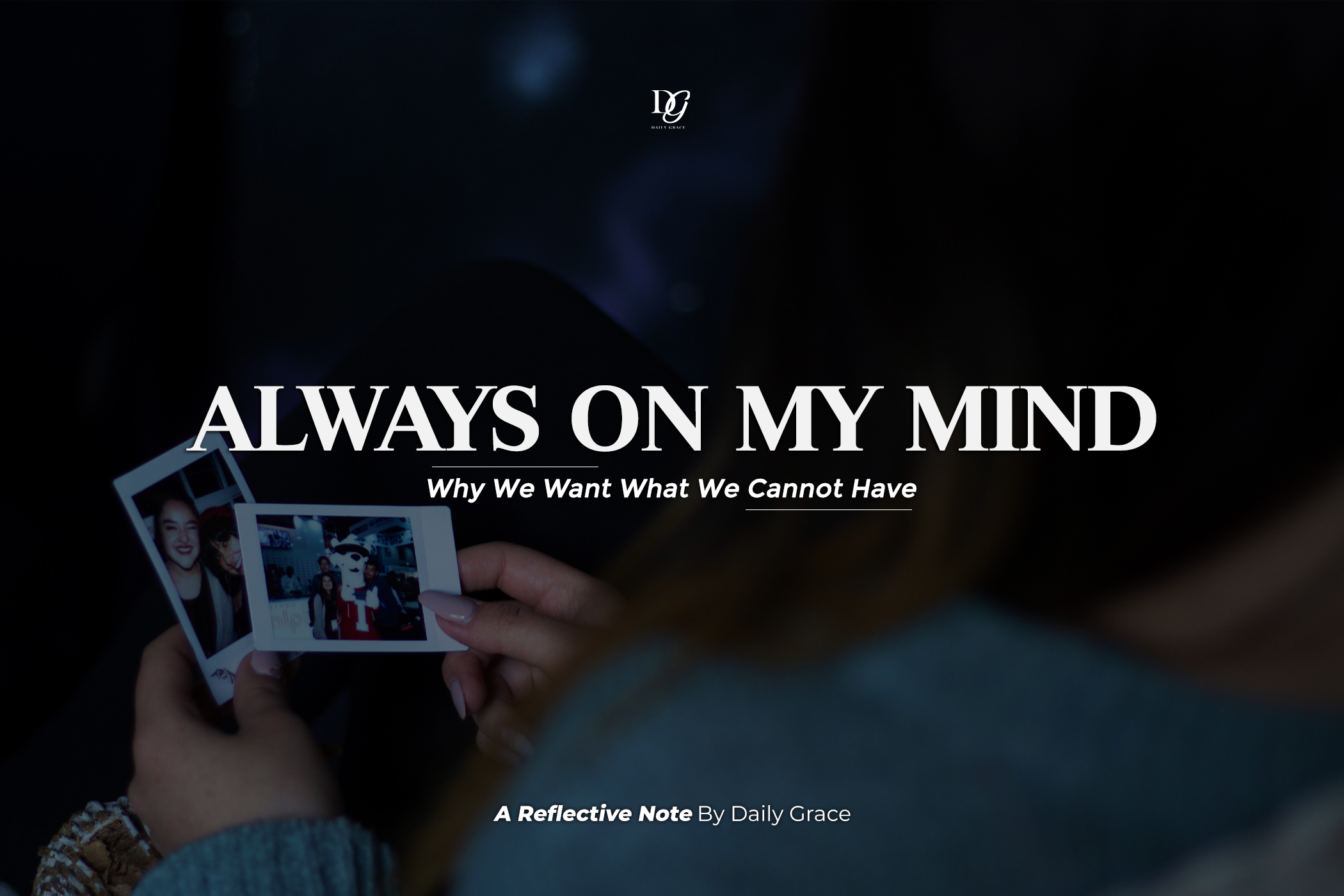
(Why We Want What We Cannot Have)
“At 15, I fell in love with a guy who was about six years older than me. At first, I thought he liked me too. Looking back now, I think I was wrong. But by the time I realised it, I was already struggling to pull myself away.
He never really gave me what I wanted, yet somehow that made me want him even more. I remember spending my little money on airtime to always call him. But he never called me. I was always the one reaching out. I always wanted to see him. Even seeing him for a few minutes could make me happy, although somewhere inside me, I knew he did not want it as much as I did.
I am 25 now, and sometimes I look back and feel embarrassed. I keep asking myself why I did that. Why did I continue desiring something that was clearly not being reciprocated? It was not love, yet, I don’t even know what it was. But whatever it was, I could not stop wanting it. And honestly, I am struggling to forgive myself for the girl I was.” – Anonymous
Reflection
There is something painful about looking back at a younger version of yourself and finally understanding what you could not understand then. You see the money spent, the unanswered calls, the emotional energy, the waiting, the hope, and you wonder, why didn’t I just walk away? But actually, that is too simple a question.
At fifteen, she was not equipped with the emotional language to understand attachment, rejection, uncertainty or the strange intensity that can come from wanting someone who does not quite want you back. She knew what she felt. She did not yet understand what was producing it.
One of the uncomfortable things about desire is that unavailability can sometimes make something feel more valuable than it actually is. When something is easily available, our minds can become familiar with it. But when access is uncertain, every small moment can feel significant. A call becomes a reward, a meeting becomes something to anticipate, even a little attention can feel disproportionately powerful because we have been waiting for it.
The inconsistency itself can keep us emotionally engaged. We begin chasing not only the person or thing, but the next moment of relief, validation or possibility.
And this is where obsession can enter. We may tell ourselves, I just really like this person, when what has actually captured us is the unresolved nature of the situation. We are no longer responding only to who they are; we are responding to the possibility of finally being chosen.
Rejection can become a challenge to our sense of worth. We start thinking, If I can just make this person love me, then perhaps I will finally feel worthy of being loved. What began as attraction can therefore become a personal mission, and the person we desire becomes attached to a much deeper need.
But we must be careful here. Understanding this does not mean romanticising one-sided pursuit. In the reader’s story, the age difference and the fact that she was only fifteen make the situation especially concerning. A young person’s feelings can be real without the relationship being appropriate or reciprocated. That distinction matters, and her emotions were not shameful. Sometimes a feeling is genuine and still needs to be released.
Perhaps the hardest confrontation is realising that wanting something intensely is not evidence that it is good for us. We often treat the strength of a feeling as proof of its importance. But intensity can come from uncertainty, loneliness, insecurity, fantasy, novelty or rejection. Something can occupy your thoughts all day and still have very little place in your life.
You can miss someone terribly and still need to leave them alone. You can desperately want an opportunity and still accept that it is not yours. Desire deserves to be understood, but it does not automatically deserve to be obeyed.
As adults, this becomes an important discipline. Before pursuing what seems irresistible, we need the courage to slow down and examine what is really driving us. Sometimes, we are not longing for the person or thing itself as much as we are longing to be chosen by it. Sometimes, we become attached not to what is real, but to what we imagine could happen. And sometimes, the very fact that something is unavailable makes us want it more than we would if it were freely within our reach.
We must therefore be careful not to mistake rejection for a challenge, uncertainty for chemistry, or intensity for genuine value. Healthy desire does not need to prove itself by chasing what refuses to meet it halfway. It allows room for mutuality, reality, and wisdom. This does not mean killing desire; it means giving desire the maturity to know when to pursue, when to wait, and when to let go.
To my anonymous reader who shared her story; you will never be able to recoup the money you spent on airtime or change the calls you made that were never returned. But, you do not need to keep punishing yourself for them. You can take the lesson instead: not everything we strongly desire is something we are meant to pursue, and not every rejection needs to be overcome; sometimes, it is something we need to accept and respect.
©️ No Copyright infringement intended.
Share your obsession-related story with us at https://www.secretmessage.link/secret/6ac369335ac45/ , and we may reflect on it to help others learn from your experience.
If you liked this content, kindly donate to support Daily Grace projects – Merchant ID: 651707 / 0596301314 (Daily Grace). Visit https://teamdailygrace.com/projects to find out more on DG Projects.
PS: Kindly Follow our WhatsApp Channel for more engaging content.

Leave a Reply